Marketing Funnel
Webinar Funnel & Automation for Sports Bettor Advisory
ZDMBets · win.zdmbets.com
Metrics
Total emails sent
- Result
- 574
Email open rate
- Result
- 16.2% (93 opens)
Total SMS sent
- Result
- 548
SMS click rate
- Result
- 96% (526 opens/reads)
Webinar registrants (total)
- Result
- 238
Landing page conversion rate
- Result
- 12%
Webinar attendance (average)
- Result
- 12 viewers/webinar
| Metric | Result |
|---|---|
| Total emails sent | 574 |
| Email open rate | 16.2% (93 opens) |
| Total SMS sent | 548 |
| SMS click rate | 96% (526 opens/reads) |
| Webinar registrants (total) | 238 |
| Landing page conversion rate | 12% |
| Webinar attendance (average) | 12 viewers/webinar |
The Client
ZDMBets is run by Zach Miller, a solo sports betting consultant who reframes sports betting not as gambling, but as a repeatable investment process. His model centers on bankroll management, educated evaluation, and long-term sustainability over short-term wins. His weekly webinar, “How to Turn Sports Betting from a Gamble into a Profitable System You Can Actually Rely On”, is a free open-to-the-public session that educates prospective members and eventually converts them into his paid advisory and mentorship group.
The marketing constraint: Sports betting-adjacent advertising is subject to platform restrictions. The campaign couldn't make earnings claims, couldn't promise financial returns, and needed to be positioned around education and process not monetary outcomes. Every piece of the funnel, from the landing page to the SMS messages and ad copy had to be compelling enough to convert, while staying responsible enough to comply.
The Funnel
The campaign was designed as a closed-loop weekly cycle:
Each touchpoint was designed to serve one of two goals: get webinar registrations or get the registrant to show up.
The Landing Page
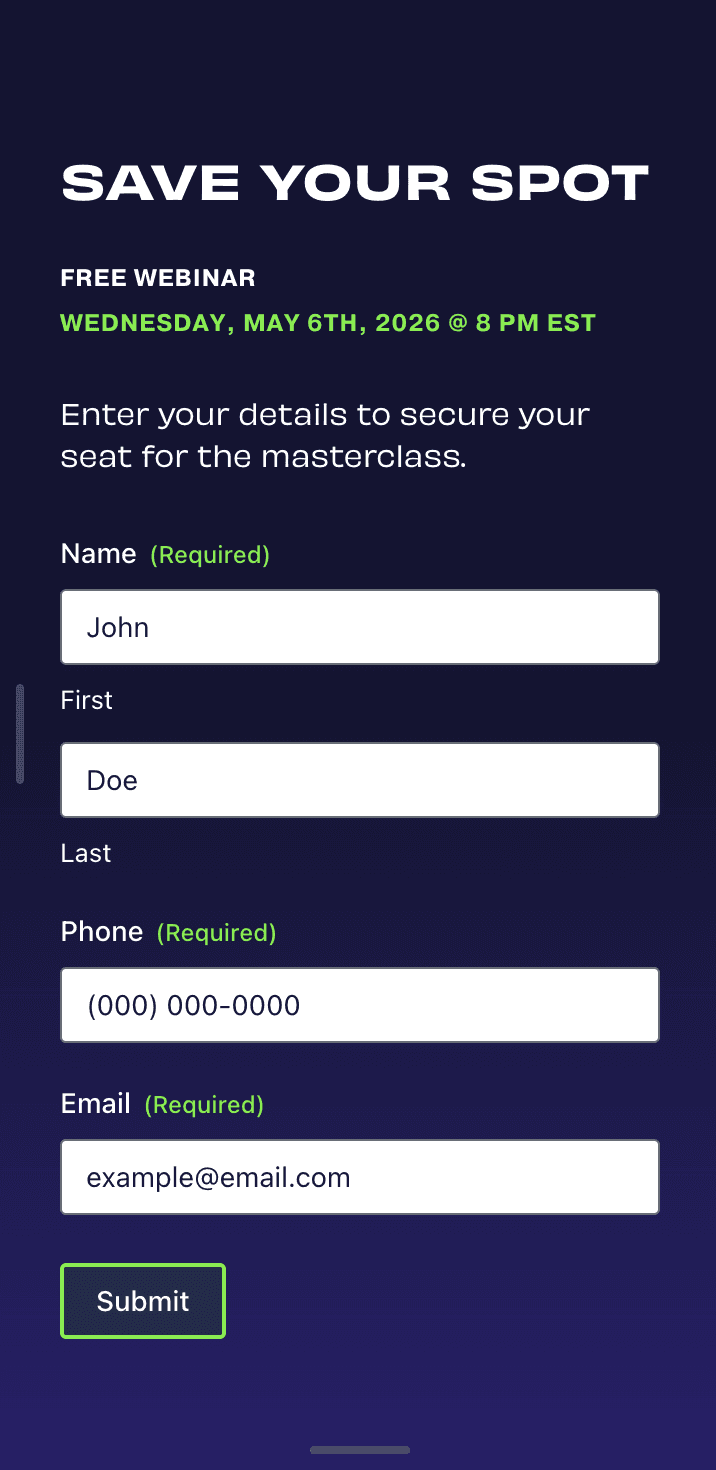
The landing page was designed mobile-first, as the primary traffic source was Meta ads. The entire registration flow needed to work primarily on smaller screens.
Design decisions:
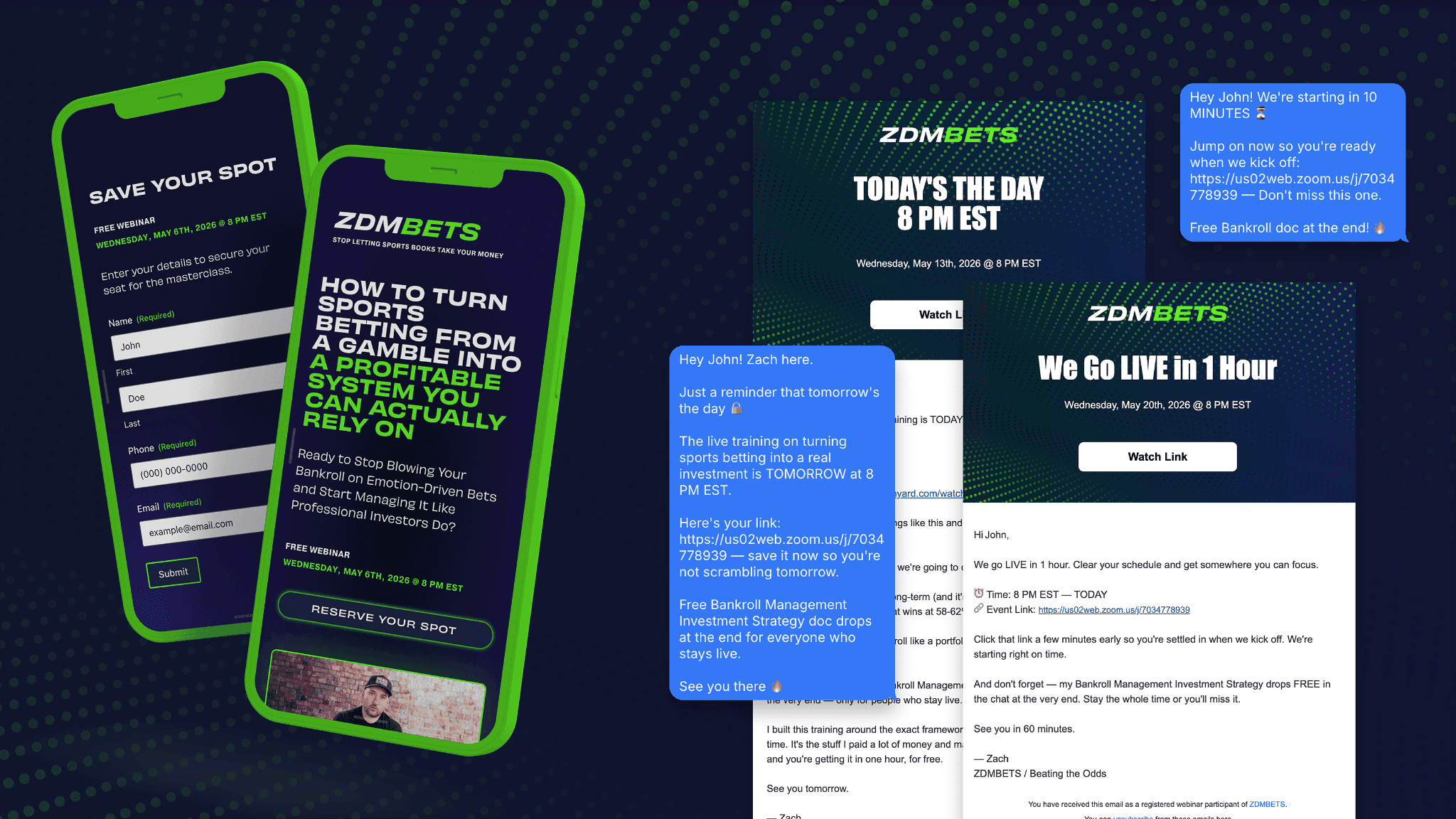
I positioned the hero to lead with a reframe rather than a promise. The headline, “How to Turn Sports Betting from a Gamble into a Profitable System You Can Actually Rely On”, aimed to position the webinar around process and methodology, not short-term winnings or cash-grab clickbait. The subheadline reinforced this: “Ready to Stop Blowing Your Bankroll on Emotion-Driven Bets and Start Managing It Like Professional Investors Do?” The betting-restriction constraint became a creative asset, allowing us to frame Zach's approach as investor-minded rather than gambling-adjacent.
ZDMBets' color palette is high-contrast and energetic, matching the betting industry while providing an elevated, educated spin on the high-risk, high-reward flashy design often seen.
The landing page followed this conversion sequence:
- Hero + Primary CTA: (Reserve Your Spot) intercept high-intent visitors immediately, repeated, solo funneling CTAs for campaigns
- Host Credibility: Zach's background and framing of the webinar content, separating mentorship from gambling platforms
- What You'll Learn: expectation setting that reinforces the investment and mentorship positioning
- Secondary CTA: second registration anchor lower in the page for scroll-through visitors
- Registration Form: Collects name, phone, email, and phone number captured for SMS and email sequence
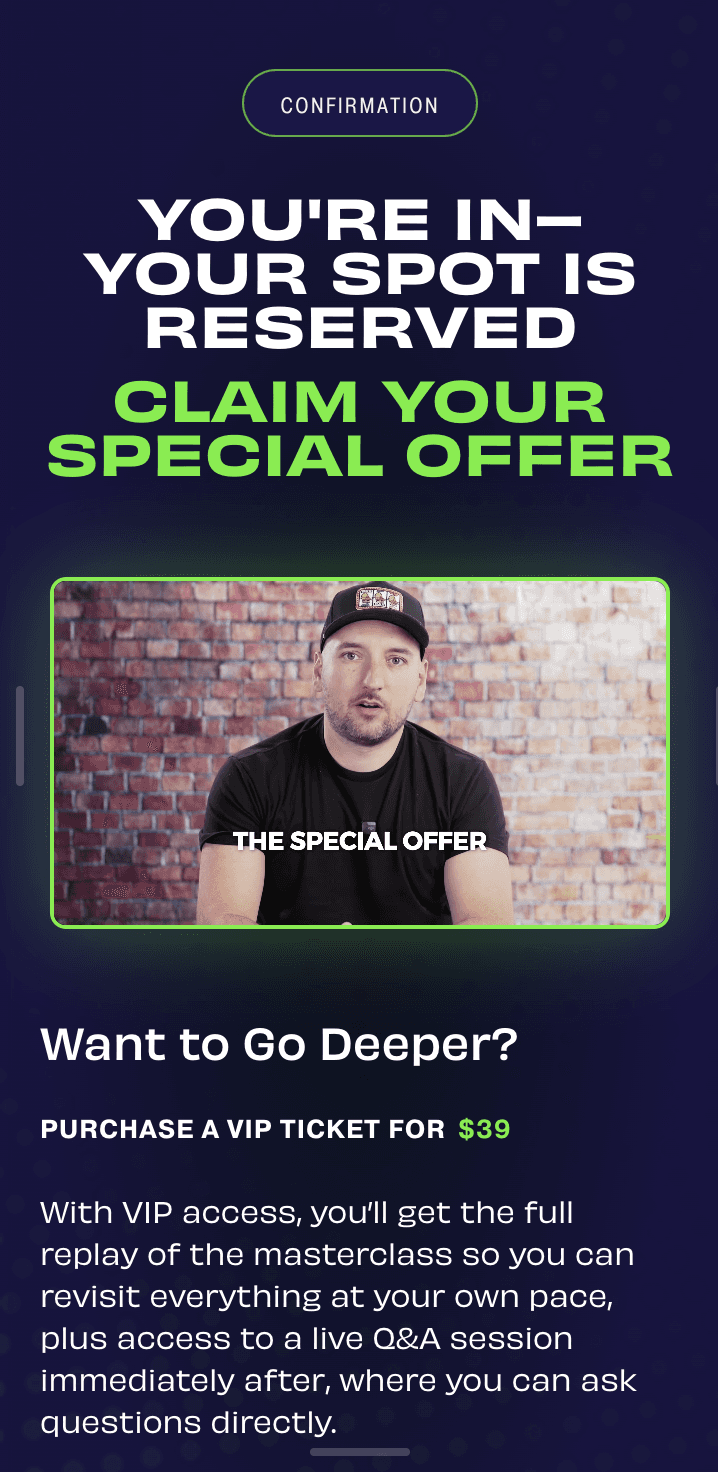
Confirmation page + upsell: After successful form completion, registrants landed on a confirmation page that surfaced a $39/VIP ticket offer, full webinar replay access, plus a live Q&A session. The upsell was supported via an embedded video from Zach that explained the offer directly, maintaining the campaign's personal tone while capturing engaged registrants.
Automations
Once a registrant submitted the registration form for a free webinar ticket, FunnelKit triggered a multi-touchpoint automated sequence timed to the Wednesday 8 PM EST webinar. Each touchpoint was designed by the client and myself to resolve low show-up rates, and warm registrants to communication with Zach.
Email Sequence
- Email 1, “Tomorrow’s the Day” (24hrs before webinar): To avoid too much communication up front for early registrants, we started the funnel 24 hours before the webinar scheduled time, to warm registrants to join.
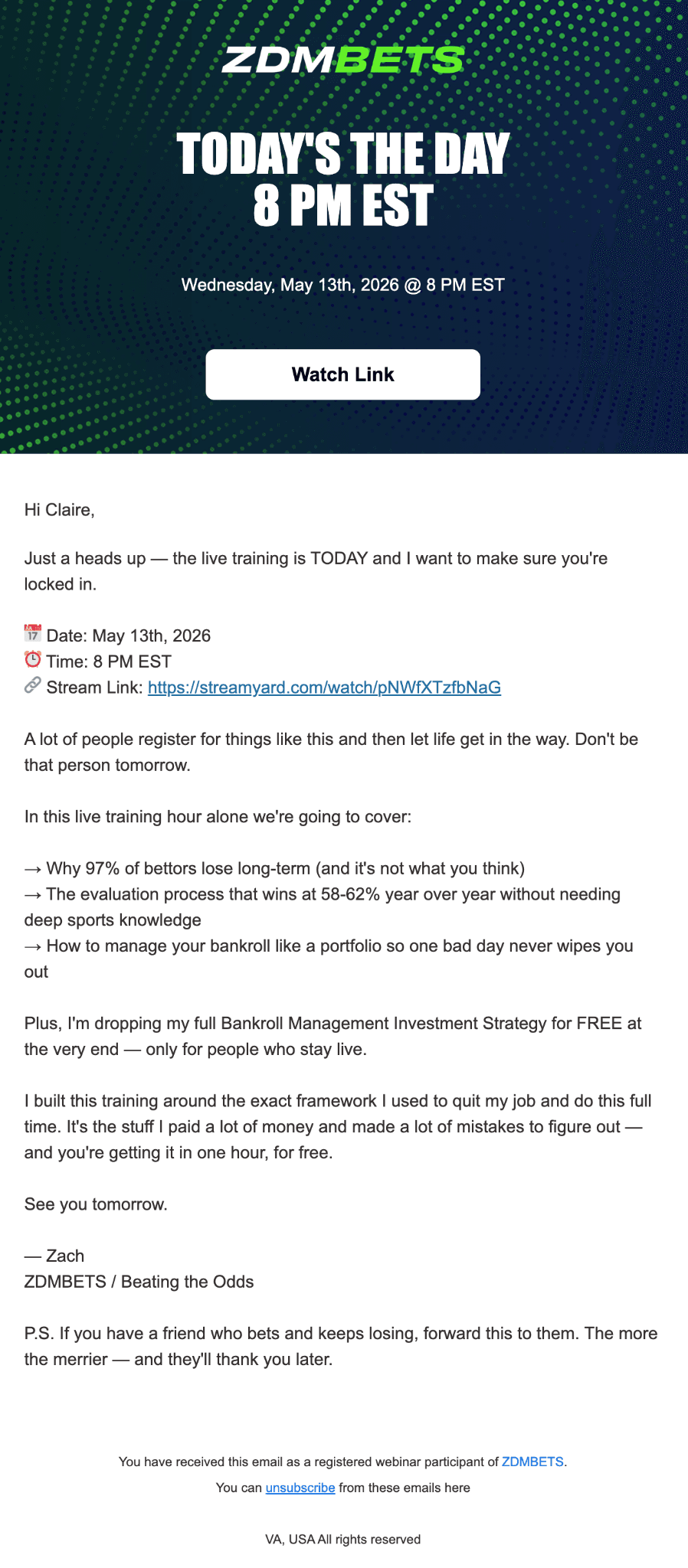
- Email 2, “Today’s the Day” (Day of webinar, morning): The following morning, a subject-level urgency email is sent to all registrants, with an overview of what will be covered, what they'll get out of joining tonight, and to stay after the main presentation for a free strategy document for those that opened the emails.
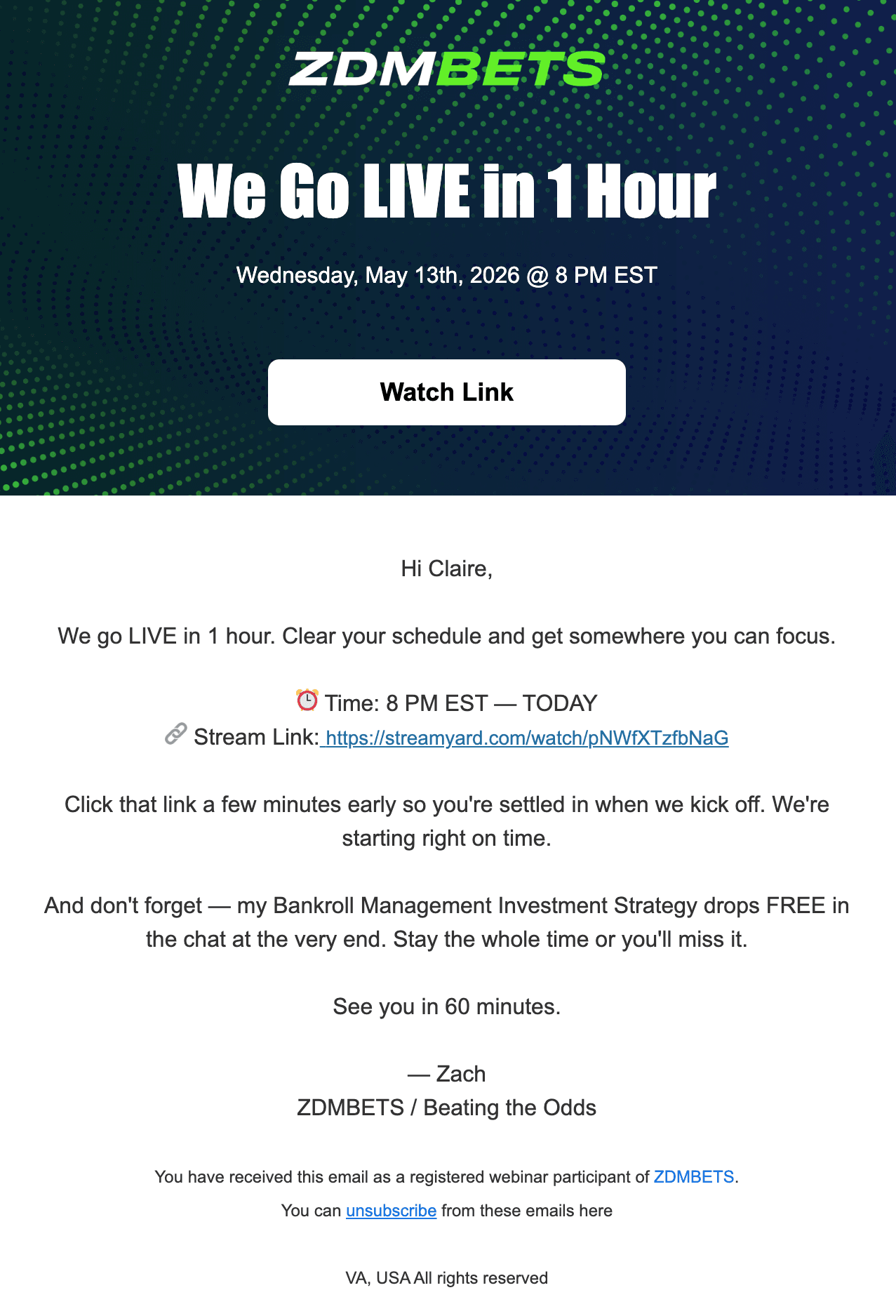
- Email 3, “We Go LIVE in 1 Hour” (1 hour before): An hour before showtime, a short, direct, and action-focused email is sent with a single CTA: Watch Link, populating the dynamic StreamYard link.
- Email 4, “We’re Live! Join Now.” (Time of webinar start): At 8 PM EST, all registrants receive the dynamic StreamYard link directly at the top of their inbox to rally them to join.
SMS Sequence
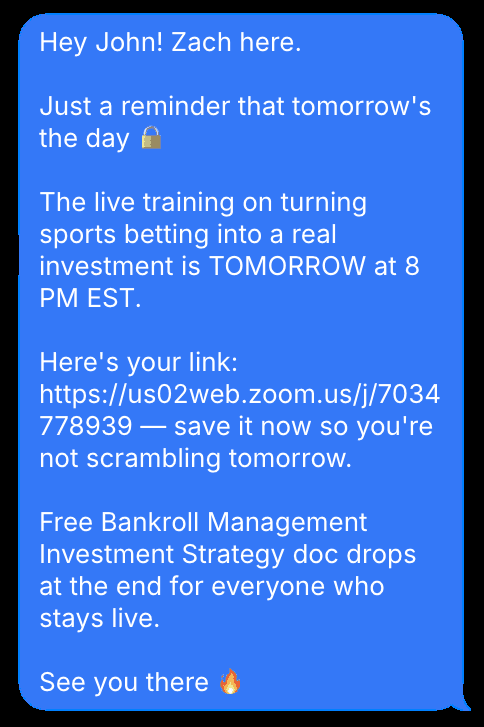
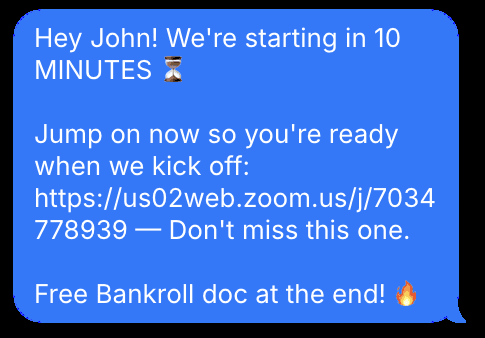
- SMS 1, (24 hours before): Opening with, “Hey [Registrant Name]! Zach here.” This message confirmed the date and time, and included the StreamYard link. Since SMS is a more direct approach, all messaging at this point is positioned to come from Zach himself.
- SMS 2, (10 minutes before): As a way to prep registrants to find a spot to log on and get ready for the webinar, this message was sent 10 minutes before the livestream begins.
- SMS 3, (Time of webinar start): With copy written to direct users to instantly join the webinar, we switched to third-person, opening with “Zach is now live!”
Sequencing
- The further from the event → more content, more context
- The closer to the event → shorter, urgent, more direct
- Email for depth and credibility; SMS for immediacy and action
Tools Used
Complexities
Most paid media campaigns I'm brought onto consists of a landing page design, A/B testing, optimization, and handoff. This campaign required connecting four separate systems into a sustainable, automated pipeline that fires accurately every week without manual intervention from our internal team, and set up the client with a reliable, repeatable funnel:
- Gravity Forms captures registrant data, including contact name, phone number, and email
- FunnelKit ingests that data, adds the contact to the correct list, and triggers the sequence
- The sequence fires on a schedule tied to the recurring webinar date
- The upsell page is triggered post-submission and tied to a separate FunnelKit product flow for the $39 VIP ticket
- SMS and email delivery required carrier compliance and opt-in language embedded in the form/privacy policy
Getting this infrastructure working correctly, and building it so it runs weekly without rebuilding, was a unique blend of functionality, engineering, and design. Instead of just a landing page, we delivered a repeatable, scalable funnel.
Outcomes
(Note: Full campaign metrics pending) The campaign has been running on a weekly cycle since launch in May of 2026, generating registrations through Meta ad traffic with automated follow-up requiring zero manual send effort from the client. The show-up incentive, free Bankroll Management document and betting advice for live attendees only, is a retention mechanism built to improve attendance rates over solely registration numbers.
VIP ticket upsells at $39 per conversion create an immediate revenue offset against Meta ad spend, making the free webinar partially self-funding.
Reflection
The design work (landing page, email templates, SMS copy) was the visual surface and hook, while the technical work underneath (form-to-CRM pipeline, automation triggers, upsell flow logic, recurring cadence setup) was what made it function as a scalable business tool rather than a one-time paid media campaign.
The betting-adjacent copy constraint was the most interesting creative challenge. The instinct in performance marketing is to lead with results. Here, every results-oriented claim had to be reframed as a process, which, in hindsight, made the positioning stronger. “Stop betting like a gambler, start betting like an investor” is a more differentiated message than any earnings claim would have been.
What I'd do differently: Implement UTM tracking parameters on the StreamYard links in every email and SMS touchpoint from day one. Attribution among the email sequence, SMS sequence, and actual webinar attendance currently relies on the platform's own reporting. Consistent UTM tagging from launch would have provided cleaner cross-channel attribution data for the client's ongoing campaign optimization.
Campaign Touchpoints
Related Work
UX/UI Strategy & Development
Agency Website Design, Development, & UI System Build
Leading the redesign of a website design agency's own website, a scalable UI system, restructured IA, and a content engine built for organic growth.
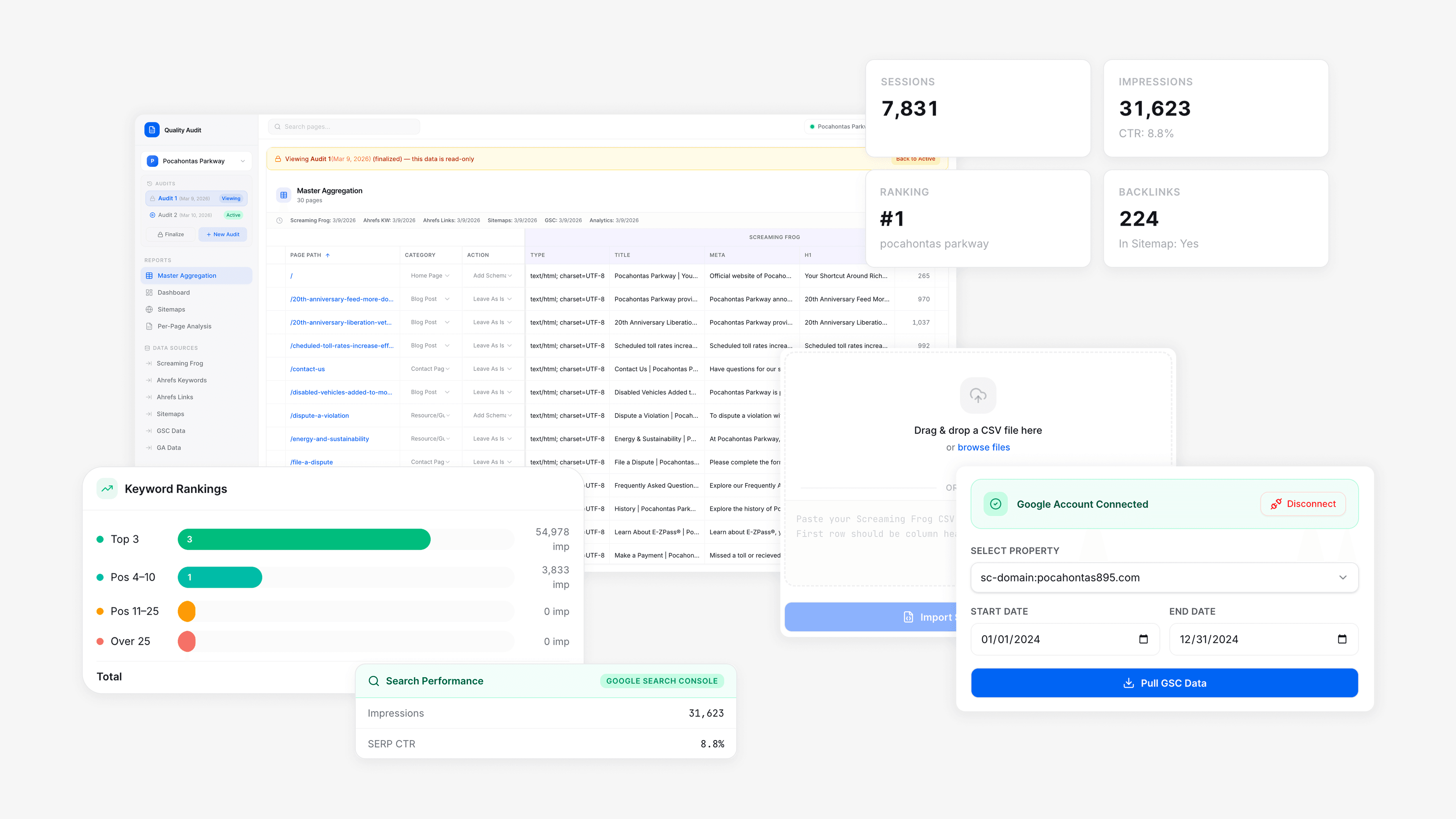
Product Design & Development
Website Quality Audit Web App
Self-serve SEO audit dashboard that replaced an outdated spreadsheet tool, cut audit timeline by 55%, and permits clients a live view into their own technical and content data.